
XPERIENCEIT PRESS IS PROUD TO PUBLISH
It is What It is: A Place to Begin with the Tao Te Ching
What I’d tell my twenty-three-year-old self after forty years
t twenty-three, Cliff Kayser encountered the Tao Te Ching in a required World Religions course and asked a question that would remain with him for forty years: Could this one help with all the others?
He kept returning to the text—through work and relationships, loss and recovery, leadership and human development, a life-changing mountain-bike accident, and the long effort to live what he could already recognize on the page.
It is What It is gathers the counsel he would place in the hands of that twenty-three-year-old now. Kayser has selected twenty-three chapters as a guided entrance to the Tao Te Ching. Each chapter pairs his poetic reinterpretation with a brief reflection drawn from lived experience and practice. The first movement names It as directly as language allows. The second turns to water, valleys, storms, roots, and other images that can carry what explanation cannot.
This is not a scholarly translation from Classical Chinese. It is an invitation to begin: to meet reality without confusing acceptance with approval, to recognize the distance between understanding and embodiment, and to remain curious enough to keep practicing.
Each chapter also opens into a free, complete Just Tao It companion essay through a direct chapter link. No account or subscription is required.
A short, compassionate place to begin when life is asking you to meet what is here before deciding what comes next.
It is What It is: A Place to Begin with the Tao Te Ching is the first of four books in the Guided Tao Series.
It: Forty Years in Conversation with the Tao Te Ching
Eighty-one spare, contemporary renderings shaped through one life’s forty-year conversation with the Tao Te Ching.
liff Kayser’s conversation with the Tao Te Ching began in 1984 and continued through four decades of leadership, human development, Polarity Thinking, loss, recovery, and ordinary life.
It gathers his interpretive renderings of all eighty-one chapters in language designed to preserve openness, cadence, and room for the reader’s own encounter. It is not presented as a direct translation from Classical Chinese, but as the record of a sustained relationship with one of humanity’s enduring wisdom texts.
No religious identity is required. Readers may enter these pages through philosophy, poetry, spiritual reflection, leadership, personal development, or simple curiosity.
Words such as “Way” and “Path” can make Lao Tzu’s subject feel more bounded than the reality toward which he points. Kayser uses It as an open pronoun: a word that can point without pretending to contain.
It preserves the eighty-one chapters in their most elemental form. The longer Just Tao It series carries them into conversation with contemporary life through personal reflection, leadership and coaching applications, Polarity Thinking, and Polarity Map® applications.
Together, they form two movements of one conversation: the source renderings carried across forty years, followed by an exploration of what they may ask of us now.
Cliff Kayser is an author, executive coach, leadership educator, and longtime practitioner of Polarity Thinking. His work explores wiser decisions, adult development, interdependent tensions, and the conditions that help people and human systems become more whole.
Read the chapters in sequence. Hold one at a time. Or open the book wherever the moment leads. No particular belief is required—only a willingness to enter the conversation.
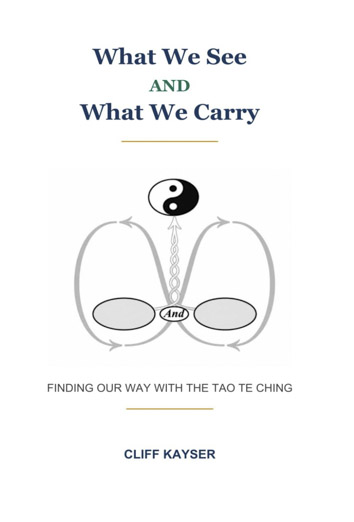
What We See AND What We Carry
Finding Our Way with the Tao Te Ching
hat has shaped the way you see? What will you take responsibility for carrying forward?
Long before we can name what matters, life places much in our hands: family and place, love and loss, loyalties and fears, gifts and burdens. These experiences become part of how we meet the world. With time, we can look again at what we have received, care for what remains ours, release what should travel no farther, and become more responsible for what passes through us into another life.
In nineteen conversations with the Tao Te Ching, Cliff Kayser follows these questions through friendship, work, grief, wonder, belonging, movement, power, and contribution. His opening letter to his eighty-three-year-old self honors Barry Johnson, whose friendship and Polarity Thinking deepened Kayser’s understanding of relationship, responsibility, and the difference one life can make.
Polarity Thinking helps reveal recurring patterns. The Tao keeps these pages open to mystery, relationship, and what no map can fully contain.
Much of the book took shape at Kayser Ridge, where waterfalls appear after rain, hummingbirds move through the pollinator garden, and an unfinished shell holds memory and possibility. The life of that place travels through these pages.
Bring your own life to the conversation. What deserves your care now? What will you carry forward? What might your carrying make possible for someone else?
Each chapter pairs a complete Tao rendering with a brief reflection and a free companion essay reached through a Yin/Yang QR code.
What has shaped the way you see? What will you take responsibility for carrying forward?
It is What It is: A Place to Begin with the Tao Te Ching is the second of four books in the Guided Tao Series. Book Three is currently in development!